Looking for Reliable Debt Collection Services in Dubai or UAE ?
Helping UAE businesses recover payments swiftly and securely.
Our Services

Debt Management

Credit Rating

Credit Control System

Legal Aid

Bad Debt Recovery

International Recovery
F & Q
What is debt collection in Dubai?
Debt collection in Dubai is a strictly regulated legal and administrative process that allows creditors to recover unpaid dues from individuals or businesses. The framework emphasizes amicable settlement and documentation before proceeding to formal litigation.
What are the legal requirements for debt collection in Dubai?
Debt collection in Dubai is a strictly regulated process that balances the rights of the creditor to recover funds with the legal protections afforded to the debtor. The framework heavily prioritizes amicable settlement and documentation before any formal litigation can occur.
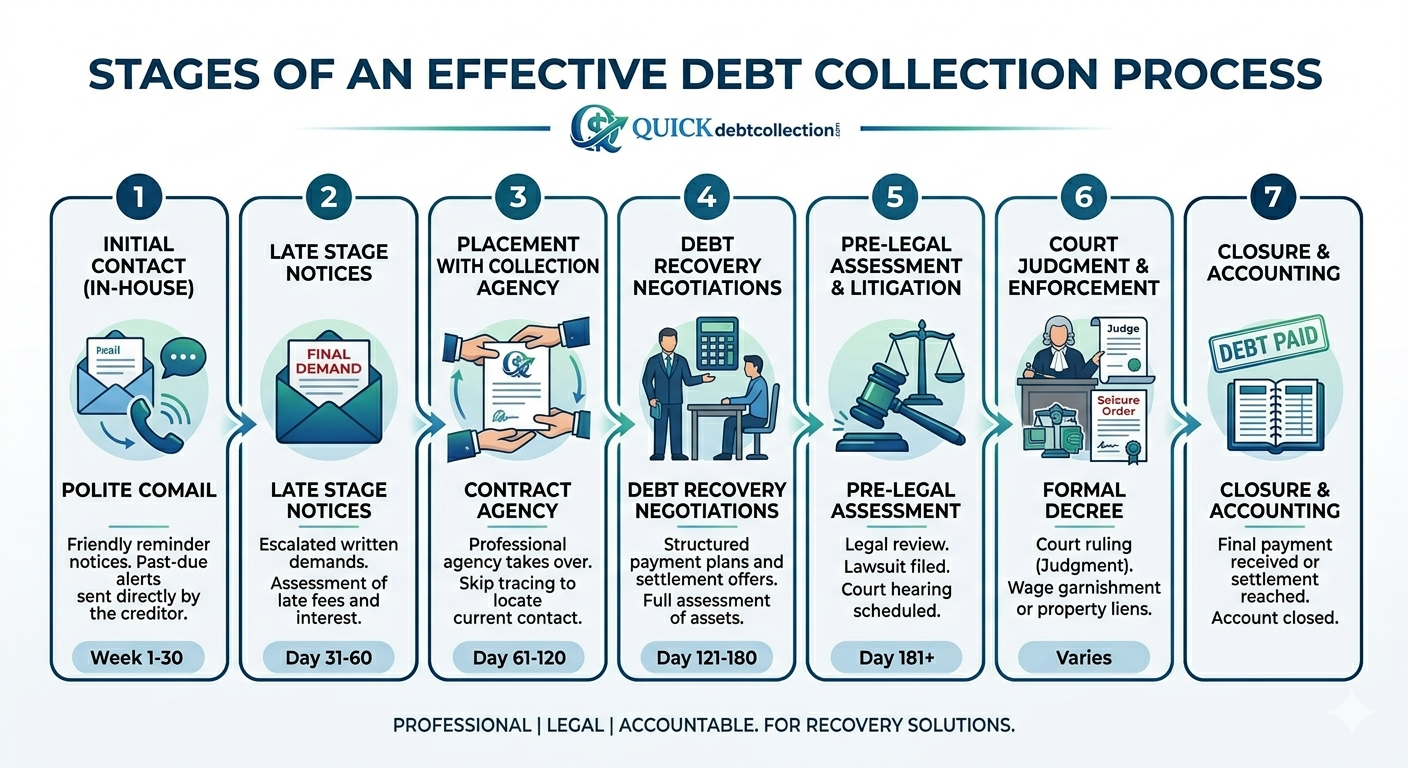
1. The Amicable Settlement PhaseThe first requirement is an attempt at “Pre-Legal” recovery. In the UAE, it is standard practice to attempt a resolution outside of court first.Negotiation: Creditors or agencies reach out via phone, email, or field visits to negotiate payment plans.Documentation: All communication must be documented to prove that a reasonable attempt at a settlement was made.
2. Formal Legal NoticeIf amicable efforts fail, a formal Legal Notice (also known as a Letter Before Action) is a mandatory prerequisite for litigation.Mandatory Warning: This letter must officially notify the debtor of the default and provide a specific grace period (usually 15 to 30 days) to settle the dues.Clarity of Claim: The notice must clearly state the exact amount owed, including any interest or late fees permitted by the contract.
3. Regulatory Compliance (CBUAE)For financial and banking debts, agencies must adhere to the Central Bank of the UAE (CBUAE) regulations.60-Day Notice Rule: Banks and collection agencies must provide a 60-day notice period for arrears before taking aggressive recovery actions.Upcoming Deadlines: As of the latest updates, entities operating in the financial space must be fully compliant with the new CBUAE regulatory framework by September 16, 2026.
4. Litigation Requirements (Civil Case)If the case moves to the Court of First Instance, several legal requirements must be met:Evidentiary Standards: UAE courts are document-focused. You must provide original contracts, signed invoices, delivery notes (LPOs), and proof of the legal notice.Language: All documents submitted to the court must be translated into Arabic by a legal translator certified by the Ministry of Justice.
5. Prohibited ConductTo remain legally compliant, debt collectors must avoid practices that violate UAE penal or privacy laws:Harassment & Coercion: Excessive calling, using threatening language, or physical intimidation is strictly prohibited and can lead to criminal charges against the collector.Privacy Violations: Disclosing debt information to third parties, such as a debtor’s employer, family members, or on social media, is a violation of data privacy laws.Unauthorized Charges: Collectors cannot add “collection fees” to the debt unless explicitly stated in the original contract between the creditor and debtor.
6. Enforcement Powers. Once a court judgment is obtained, the Execution Department can legally enforce payment through:Travel Bans: Preventing the debtor from leaving the country.Asset Seizure: Freezing bank accounts or seizing vehicles and commercial licenses.For your business, Debtcop, staying aligned with these requirements—especially the 2026 CBUAE compliance deadline—is essential for maintaining a professional and legally sound operation.
How can a debt collection agency help me recover my debts in Dubai?
A debt collection agency in Dubai assists you by acting as a professional intermediary, utilising specialised market knowledge and legal expertise to recover unpaid dues efficiently. Their primary goal is to secure payment through amicable settlement before escalating to formal court procedures.
1. Professional Negotiation & MediationNeutral Third Party: Agencies act as neutral intermediaries, which helps maintain professional relationships between you and your debtor.Psychological Tactics: Professionals use “behavioral nudging” and urgency-based messaging to persuade debtors to prioritize your payment.Customized Repayment Plans: They negotiate structured settlement agreements and flexible payback arrangements that are mutually acceptable, often retaining customers who might otherwise be lost.
2. Strategic Recovery StepsLocating Debtors: Agencies use local networks, credit checks, and commercial databases to find debtors who may have “ghosted” or moved.Formal Communication: They establish formal channels through structured phone calls, emails, and physical field visits.Demand Letters: Agencies issue formal, registered legal demand notices that warn of potential legal repercussions, often prompting payment within a 15-day deadline.
3. Legal Expertise & ComplianceLocal Law Compliance: Agencies ensure all recovery actions adhere strictly to UAE commercial laws, such as Federal Law No. 18 of 1993, minimizing your risk of legal disputes or harassment claims.Due Diligence: They conduct thorough investigations into a debtor’s financial health and the validity of their trade licenses before recommending a course of action.Litigation Support: If amicable efforts fail, they guide you through the Dubai Courts to obtain and enforce judgments, which can include asset seizure or travel bans.
4. Operational EfficiencyResource Savings: Outsourcing allows your team to focus on core business growth rather than the labor-intensive task of “chasing” payments.Advanced Technology: Many Dubai agencies leverage AI-enabled analytics and automated reminder systems to track and manage debts more effectively than most in-house teams.Cash Flow Forecasting: By providing accurate timelines for recovery, agencies help you better anticipate and manage your business’s financial liquidity
What are the costs associated with debt collection in Dubai?
The costs associated with debt collection in Dubai are structured to accommodate both the administrative reality of the UAE and the risk-reward nature of recovery. Generally, these costs are split into agency fees and legal/administrative expenses.
Debt Collection Agency FeesIn Dubai, professional agencies like Debtcop typically work on a “No Win, No Fee” basis (Contingency Model).Contingency Fees: These range from 10% to 15% of the recovered amount. The specific percentage depends on the age of the debt, the total value, and whether it is a B2B or B2C claim.
Retainer/File Opening Fees: Some agencies charge a small one-time administrative fee AED 1000 to cover initial due diligence, skip tracing, and the issuance of formal demand letters.
What are my rights as a debtor during debt collection in Dubai?
As a debtor in Dubai, your rights are protected under a combination of UAE Federal Law and Central Bank regulations designed to prevent unfair treatment and ensure data privacy.
1. Protection from HarassmentDebt collection practices must remain professional and respectful at all times.Excessive Contact: You have the right to be free from persistent or excessive phone calls.Coercion and Threats: Collectors are strictly prohibited from using verbal or physical threats, intimidation, or any form of coercion.Timing: While the law encourages amicable outreach, collectors must not contact you during unreasonable hours or in a manner that disrupts your life.
2. Right to Privacy and Data ProtectionCollectors must handle your personal and financial information with strict confidentiality.Third-Party Disclosure: A debt collection agency cannot legally disclose your debt status to your employer, family members, or neighbors without your explicit authorization.Public Shaming: Using social media or public platforms to pressure a debtor is a violation of UAE privacy and penal laws.
3. Mandatory Notice PeriodsFor banking and financial debts, specific timelines must be followed before aggressive recovery actions are taken.60-Day Notice: Under Central Bank of the UAE (CBUAE) regulations, institutions are required to provide a 60-day notice period for arrears before escalating to more serious recovery measures.Formal Warning: You have the right to receive a formal Legal Notice (Letter Before Action) that clearly states the amount owed and provides a final grace period (typically 15 to 30 days) to settle the dues before litigation begins.
4. Right to Negotiation and DocumentationThe UAE legal framework prioritizes amicable settlements over court cases.Amicable Settlement: You have the right to negotiate payment plans or structured settlements that are mutually acceptable.Evidence Review: You have the right to see the documentation supporting a claim, such as original contracts, signed invoices, or delivery notes.No Unauthorized Fees: Collectors cannot add “collection fees” or administrative charges to your balance unless those fees were explicitly agreed upon in your original contract with the creditor.
5. Legal Protections in CourtIf a case proceeds to litigation, you have specific procedural rights in the Dubai Courts.Arabic Translation: You have the right to receive all court-submitted documents in Arabic, as this is the official language of the UAE legal system.Due Process: You have the right to present your defense in the Court of First Instance before any enforcement measures—such as travel bans or asset seizures—are finalized.
What should I do if I believe a debt collector is violating my rights?
If you believe a debt collector in Dubai is violating your rights, you should take immediate, documented action to protect your legal position. The UAE has a structured hierarchy for reporting misconduct, especially given the strict regulations regarding privacy and professional conduct.Here is the step-by-step process you should follow:
1. Immediate DocumentationBefore filing a formal complaint, gather all evidence of the violation:Call Logs: Keep a record of the frequency and timing of calls to prove harassment.Communications: Save all SMS, emails, and WhatsApp messages.Recordings: Where legal and possible, keep recordings of any verbal threats or unprofessional language.Third-Party Evidence: If a collector contacted your employer or family members, obtain written confirmation from those individuals to prove a privacy violation.
2. Submit a Written Complaint to the AgencyStart by addressing the issue directly with the management of the debt collection agency or the creditor:Formality: Send an official email or registered letter outlining the specific violation (e.g., harassment, disclosure of data to third parties, or unauthorized fees).Demand Cease and Desist: Explicitly state that their current methods are in violation of UAE law and demand that they stop immediately.
3. Escalate to the Central Bank of the UAE (CBUAE)If the debt is related to a bank or financial institution, the CBUAE is the primary regulatory body:Consumer Protection: You can file a complaint through the Sanadak platform (the Ombudsman unit for financial institutions).Focus Areas: The CBUAE specifically handles violations of the 60-day notice rule and cases involving the disclosure of private financial data.
4. Report to the Dubai PoliceIf the violation involves criminal behavior, you should bypass administrative complaints and go to the police:Criminal Offenses: Threats of violence, physical intimidation, or severe harassment are criminal acts under the UAE Penal Code.e-Crime Portal: You can report digital harassment or threats through the Dubai Police e-Crime website or mobile app.
5. File a Case with Dubai CourtsIf the agency’s actions have caused you significant financial or reputational damage:Civil Claim: You may seek legal counsel to file a civil suit for damages.Privacy Law: Under UAE data protection and privacy laws, unauthorized disclosure of your debt status can be grounds for legal action
Can a debt collector contact my friends, family, or employer?
In Dubai, a debt collector cannot legally contact your friends, family, or employer to pressure you or disclose your debt without a court order or your explicit consent. UAE law and the Central Bank (CBUAE) enforce strict privacy and consumer protection rules that define such actions as illegal harassment.
1. Contacting Your Friends and FamilyDebt collectors are prohibited from disclosing your financial details to third parties, including family members.Privacy Protections: Federal Decree-Law No. 45 of 2021 (Data Protection Law) treats your financial information as private. Disclosing your debt to relatives without a legal basis is unlawful and can result in hefty fines for the agency, ranging from AED 50,000 to AED 100,000.Notification Exception: A creditor may deliver a formal notice to an adult family member at your residence only as a means of legal service, but they cannot use them as a “tool” to pressure you for payment.
2. Contacting Your EmployerA debt collector is not allowed to call your workplace or contact your employer to shame or pressure you.Court Order Required: They can only involve your employer if they have obtained a court order, typically during the “Execution” stage of a legal case.Salary Garnishment: Only after a court delivers a verdict can authorities lawfully contact your employer to arrange salary deductions, which are usually capped at 25–50% of your wages.Illegal Conduct: Unsolicited workplace visits, emails to HR, or calls to colleagues are considered harassment.
3. What is Considered Illegal Harassment?According to CBUAE regulations and UAE law, the following tactics are prohibited:Disclosure to Third Parties: Sharing debt details with anyone other than the debtor without consent or a court order.Workplace Shaming: Sending messages to workplace groups or contacting your manager to pressure you.Excessive Communication: Calling late at night or repeatedly after you have requested a specific contact window.Threats: Using abusive language or threatening arrest for unpaid loans where no fraud exists (debt itself is a civil matter).
How can I verify the legitimacy of a debt collection agency?
Verifying the legitimacy of a debt collection agency in Dubai is a critical step to ensure you are dealing with a licensed professional and not a fraudulent entity. Given the strict regulations in the UAE, you can use several official channels to confirm their status.
1. Check the Commercial LicenseEvery legal entity in Dubai must have a valid trade license issued by the Department of Economy and Tourism (DET) or a specific Free Zone authority.
2. Inspect Official Communication ChannelsFraudulent collectors often use generic or informal communication methods.Domain Matching: Check if their email address matches an official company domain (e.g., @debtcop.ae) rather than a public service like Gmail or Yahoo.Physical Office: Legitimate agencies in Dubai almost always have a physical office address that can be verified on Google Maps or through their trade license.Official Letterheads: Formal demand letters should contain the company’s full legal name, address, TRN (Tax Registration Number), and contact details.
3. Verify the Creditor’s AuthorisationA legitimate agency will always be able to prove they have the right to collect the debt.Letter of Authority: Ask for a copy of the “Authorisation Letter” or “Power of Attorney” from the original creditor that grants the agency permission to act on their behalf.Contact the Creditor: Call the bank or company you originally owed money to and ask them to confirm if they have assigned your file to that specific agency.
What is the role of a credit counselor in debt management?
Credit counselors are professionals who help individuals manage their debt, create budgets, and provide financial education. They may negotiate with creditors on your behalf to lower interest rates, waive fees, or create a repayment plan to help you pay off your debts more effectively.
Can a debt be sold to another debt collector?
Yes, a debt can be sold to another debt collector, often at a reduced price. The new debt collector then becomes the legal owner of the debt and has the right to pursue the collection of the outstanding amount.
Stay Informed
Get timely updates on managing your receivables and credit decisions with our expert insights.